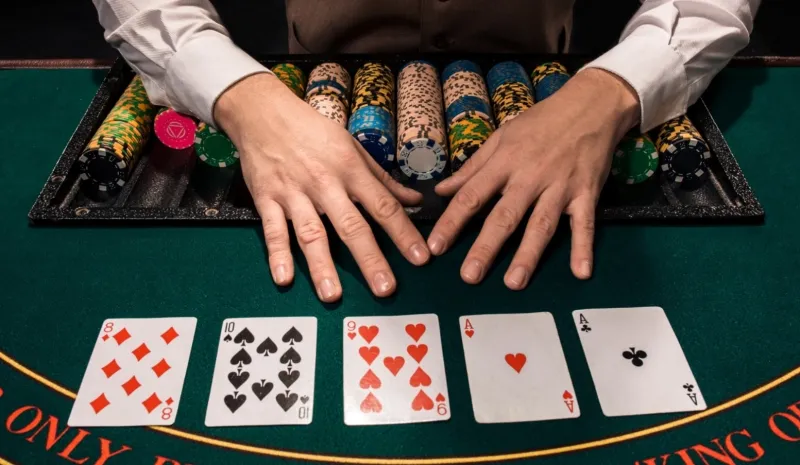
Chasing Ghosts: The 'Hot Table' Fantasy That's Quietly Draining Your Bankroll
Photo: Sozi, Public domain, via Wikimedia Commons
You've been there. You hop onto a blackjack table, win three hands back-to-back, and suddenly the whole session feels different. The table is alive. Something is happening here, you think. You'd be a fool to walk away now.
Except nothing is happening. Not really.
That electric feeling — the sense that momentum is building, that the cards are bending your way, that you've somehow tapped into a vein of luck — is one of the most convincing illusions the human brain produces. And for online players, it's costing real money every single day.
Your Brain Was Built to Find Patterns. That's the Problem.
Human beings are, at their core, pattern-recognition machines. It's not a flaw — it's an evolutionary feature. For hundreds of thousands of years, the ability to spot patterns kept people alive. Notice that certain berries grow near a particular type of rock? Pattern recognition. Realize that predators tend to move during dusk? Pattern recognition. The brain rewards this skill with a little hit of dopamine every time it successfully identifies a sequence.
The problem is that this system doesn't come with an off switch. It fires whether the pattern is real or imaginary.
Dr. Michael Gazzaniga, a neuroscientist at UC Santa Barbara whose research on the brain's "interpreter" function has been widely cited in behavioral psychology, found that the left hemisphere of the brain is essentially obsessed with creating coherent narratives — even when the underlying data is completely random. When you win four spins in a row on an online slot, your brain doesn't register "four independent random events." It registers "a pattern," and it immediately starts constructing a story around that pattern.
That story is: this table is hot.
Confirmation Bias: The Engine Behind Every False Streak
Once your brain has decided a table is running hot, confirmation bias kicks in and does the rest of the work. Confirmation bias is the well-documented cognitive tendency to seek out, notice, and remember information that supports what you already believe — while filtering out everything that contradicts it.
In practice, this means you vividly remember the five wins that "confirmed" the hot streak. You barely register the six losses scattered in between. The wins feel significant and connected. The losses feel like noise.
Talk to any experienced online player and you'll hear versions of this story.
"I was up maybe forty bucks on a roulette table and I just knew it was my night," says Marcus, a 34-year-old from Phoenix who plays regularly on mobile. "Red had come up four times straight. I kept pushing it. By the end of the session I'd burned through two hundred dollars trying to ride something that wasn't even there."
His experience is almost textbook. The initial wins created a narrative. The narrative triggered confirmation bias. The losses that followed got mentally filed away as temporary interruptions rather than evidence that the streak never existed.
What 'Random' Actually Means for Online Games
Here's the mechanical reality: legitimate online casino games — slots, roulette, baccarat, and most card game variants — operate on Random Number Generators, or RNGs. These are algorithms specifically designed to ensure that each outcome is statistically independent from every previous outcome.
That's the key phrase: statistically independent.
The roulette wheel does not remember that red came up four times. The slot machine has no internal clock ticking toward a payout. The blackjack deck (in RNG-based online versions) doesn't carry forward any momentum from the last hand. Every single result is generated fresh, with the same underlying probability, every single time.
This is not a controversial claim — it's a mathematical certainty that RNG-based platforms are required to maintain, and reputable operators are audited regularly to verify it. The concept of a "hot table" simply has no mechanism through which it could exist.
And yet the feeling persists. Because the feeling isn't coming from the table. It's coming from you.
The Selective Memory Trap
Beyond confirmation bias, there's another cognitive process at work: selective memory. Psychologists have found that emotionally charged events are encoded more strongly in memory than neutral ones. Wins — especially unexpected wins or wins during a perceived streak — carry a strong emotional charge. They get remembered clearly, with detail and feeling attached.
Losses, particularly when they feel "routine" or when the player has mentally dismissed them as noise, get stored with much less intensity.
Over time, this creates a distorted personal history. Players genuinely remember winning more than they lost during certain sessions, because the wins were stored vividly and the losses were not. This isn't dishonesty — it's just how human memory works. But it makes the illusion of hot tables feel personally validated, because your own memory seems to confirm it.
"I would have sworn I was net positive on that table for weeks," says Janelle, a 29-year-old from Atlanta. "When I actually started keeping a log, I realized I'd been down the whole time. My brain had just been keeping score differently than reality was."
A Practical Framework for Catching Yourself in the Moment
Recognizing these biases intellectually is one thing. Catching them in real time, when dopamine is flowing and the session feels electric, is considerably harder. A few practical approaches that experienced players use:
Write it down as you go. Keeping a live session log — even just a quick note of wins and losses as they happen — bypasses selective memory entirely. Numbers don't lie the way feelings do.
Set a 'narrative check' trigger. Any time you catch yourself using the phrase "this table is hot" or "I'm on a streak," treat it as an automatic warning signal. That specific thought pattern is exactly where confirmation bias lives.
Apply the coin flip test. Ask yourself: if I flipped a coin and got heads five times in a row, what are the odds of heads on the sixth flip? The answer is still 50/50. Translate that logic directly to whatever game you're playing.
Separate session energy from session results. A session can feel electric and still be unprofitable. Learning to distinguish between emotional energy and actual data is one of the most valuable skills a player can build.
The Table Was Never Hot. You Were.
There's something almost poetic about the hot table myth — because in a sense, the thing that's running hot is never the game. It's the player. It's the heightened state of focus, the emotional investment, the dopamine response to early wins that makes everything feel more vivid and connected.
That state is real. The pattern it's projecting onto the game is not.
At WinPH777, we think the best players are the ones who can hold both of those truths at the same time — enjoying the ride while keeping one clear eye on what the numbers are actually saying. The game doesn't have momentum. But your decision-making does. And that's the one streak worth protecting.